#530 (AB2) WOLLEMI PINE
Wollemia nobilis
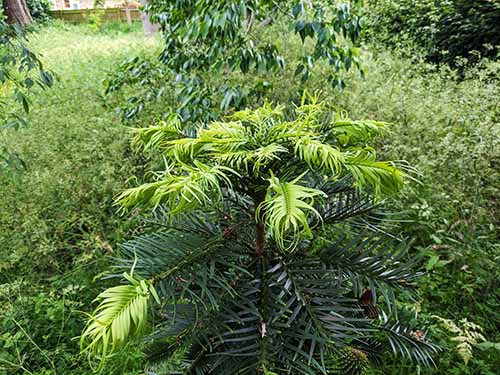
Planted: 2021
This tree is on the bank to the north of the Malus Avenue.
| Distribution: | The Wollemi Pine is found growing in a remote series of narrow, steep-sided, sandstone gorges 93 mi north-west of Sydney, Australia. Critically endangered in the wild but cultivated widely. |
| Planting Date: | Pot grown by George Marshall. Planted in the Arboretum on 6th November 2021. |
| Growth Habit: | An evergreen tree reaching 25–40 m (82–131 ft) tall. The tree coppices readily, and in the wild most specimens are multiple-trunked or appear as clumps of trunks thought to derive from old coppice growth, with some consisting of up to 100 stems of differing sizes. Branching is unusual in that nearly all the side branches never have further branching. Note ‘coppice’ growth starting at the base of our trees. |
| Bark: | The bark is very distinctive, dark brown, and knobbly. |
| Leaf: | The leaves are flat linear, 3 to 8 cm long and 2 to 5 mm wide. They are arranged spirally on the shoot but twisted at the base to appear in two or four flattened ranks. As the leaves mature, they develop from bright lime-green to a more yellowish-green |
| Cones: | Male and female cones are borne on the same tree. Male: The male (pollen) cones are slender conic, 5 to 11 cm long and 1 to 2 cm in diameter. Reddish-brown in colour and lower on the tree than the seed cones. Female: The seed cones are green, 6 to 12 cm long and 5 to 10 cm in diameter. They mature about 18 to 20 months after wind pollination. |
| Seeds: | The seeds are small and brown, thin and papery. With a wing around the edge, to aid wind-dispersal. |
| Uses: | Now widely grown as a novelty in gardens and arboreta. |
| Plant Hunter: | Wollemia was discovered, in September 1994, by David Noble, an Australian canyoner with sufficient botanical knowledge to realise that he had found something unusual. |
| Introduction Date: | 1994 |
| Anecdotes and Comments: | Wollemia is named after the Wollemi National Park, part of the Greater Blue Mountains Area, a UNESCO World Heritage Site, in New South Wales Australia. The specific name nobilis is in honour of its discoverer David Noble. Related to the Chilian Pine (Monkey Puzzle Tree), Arucaria aruucana, and the Norfolk Island Pine, Arucaria heterophylla. But only distantly to true pines. |