#454 (P2) DATE PLUM
Diospyros lotus (f)
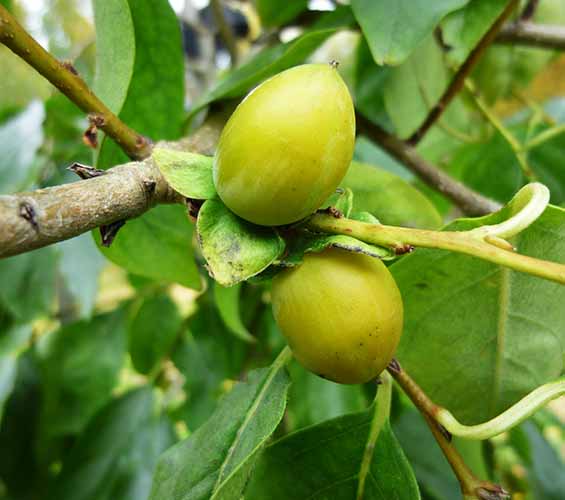
Planted: 2009
This tree is on the north side of the Malus Avenue, near the playing field hedge.
| Distribution: | Native to south-west Asia and widely naturalised in Japan and China, the Himalayas and westwards. Occasionally planted in Britain. |
| Supplier: | Royal Horticultural Society Garden Centre, Wisley, Surrey, |
| Appearance: | Small deciduous tree. |
| Growth Habit: | Narrowly domed or spreading. |
| Bark: | Grey or pink-tinged when young, becoming dark, broken by fissures into small rough oblong plates when mature. |
| Leaf: | Ovate to lanceolate with pointed tips and entire margins. Very dark glossy green above, greyer below. Young leaves slightly downy above. Remaining green into Autumn and winter. |
| Flowers: | Male and female flowers do not grow on the same tree. This is a female tree. The 5mm bell-shaped flowers are burgundy brown with 4 strongly re-curved petals framed by a saucer of four expanded sepals. There is a male tree in the Chinese and Japanese section; #60. |
| Fruit: | Small gooseberry-shaped fruits, on the female tree, sit closely against the branch with the drying sepals persistent while they go from greenish yellow to blue- black, at which point they are edible. They can be dried to taste like date. |
| Toxicity: | Edible only at the point of going bad. |
| Ultimate tree size: | 15 to 30m in height, but grows slowly once it is above 15m. |
| Uses: | In China the buds, flowers and fruit pods are used to clear fevers, stop bleeding and control dizziness. Flowers used to treat high blood pressure. Pods yield yellow fabric dye. Wood is durable, pliable, resists rot. Used in construction and general carpentry. |
| Plant Hunter: | French Jesuit priest, Pierre Nicholas le Cheron d’Incarville, gave precious seed to a Russian caravan to bring them back to Europe circa 1747. The first seeds were successfully germinated in the Jardin des Plantes in Paris. |
| Introduction Date: | Known by 1597 in East Asia. The first trees appeared in England in 1753. |
| Comments: | A member of the Ebony family and related to the Persimmon (Sharon fruit). Also known by the common names Caucasian persimmon and lilac persimmon. It is among the oldest plants in cultivation and a candidate for the Lotus in Homer’s Odyssey ‘Land of the Lotus Eaters’. |