#417 (Sh.M17) GLORY FLOWER
Clerodendrum bungei
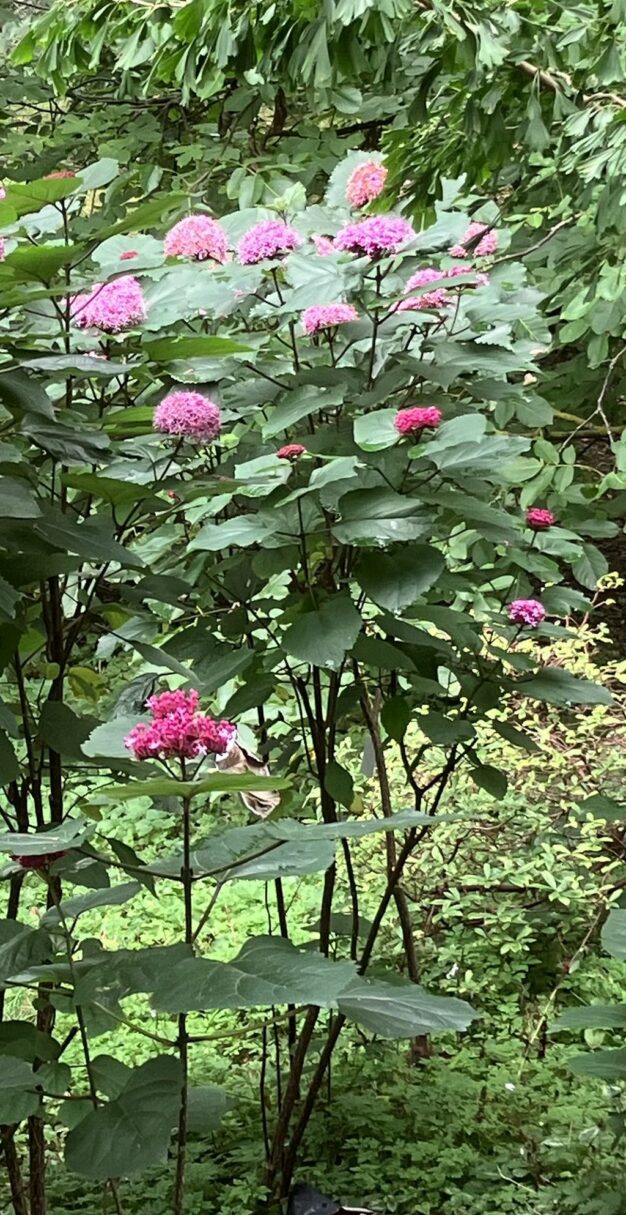
Planted: 2007
This shrub is spread across the bank between the steps up to the Chinese and Japanese section and the Edward Road fence.
Other common names are: rose glory flower, or Mexican hydrangea (though neither a Hydrangea nor from Mexico).
Native to Taiwan, Vietnam, and China. It grows along roadsides and in mixed forests on mountain slopes below 2500 m. It has escaped from cultivation in the Americas and is naturalised in some southern US states.
Supplied by Bluebell Arboretum & Nursery, Smisby, Ashby de la Zouch, Leicestershire.
A deciduous ornamental shrub that grows up to 2 m in height. Its leaves are heart-shaped), 10 to 20 cm long and not quite as wide, with coarsely toothed edges. The flowers are coloured rose, crimson, or pink, and arranged in a conspicuous rounded inflorescence 10 cm in diameter. While the flowers are fragrant, crushed leaves have an unpleasant odour. The flowers produce a sweet secretion which attracts butterflies, ants and other insects. Noted for its suckering habit and rapid growth which allow it to form spreading colonies.
Discovered in 1831 by Russian botanist Alexander von Georg von Bunge (1803 – 1890) in Beijing. Two years later, he described it as Clerodendrum foetidum, on the account of the pungent smell of its leaves. Since that name had already been occupied by another species, German botanist Ernst Gottlieb von Steudel (1783 – 1858) renamed it Clerodendrum bungei in 1840. The species name is composed of Greek words meaning “chance” and “tree” and honours Alexander von Bunge.[7]
Introduced into Europe circa 1850 by Scottish plant collector Robert Fortune (1812 – 1880).
Often grown as a greenhouse plant and in containers to be overwintered indoors. In the British Isles it is frequently killed to the ground by frost only to send up vigorous shoots the next year.