#409 (M9) LACEBARK PINE
Pinus bungeana
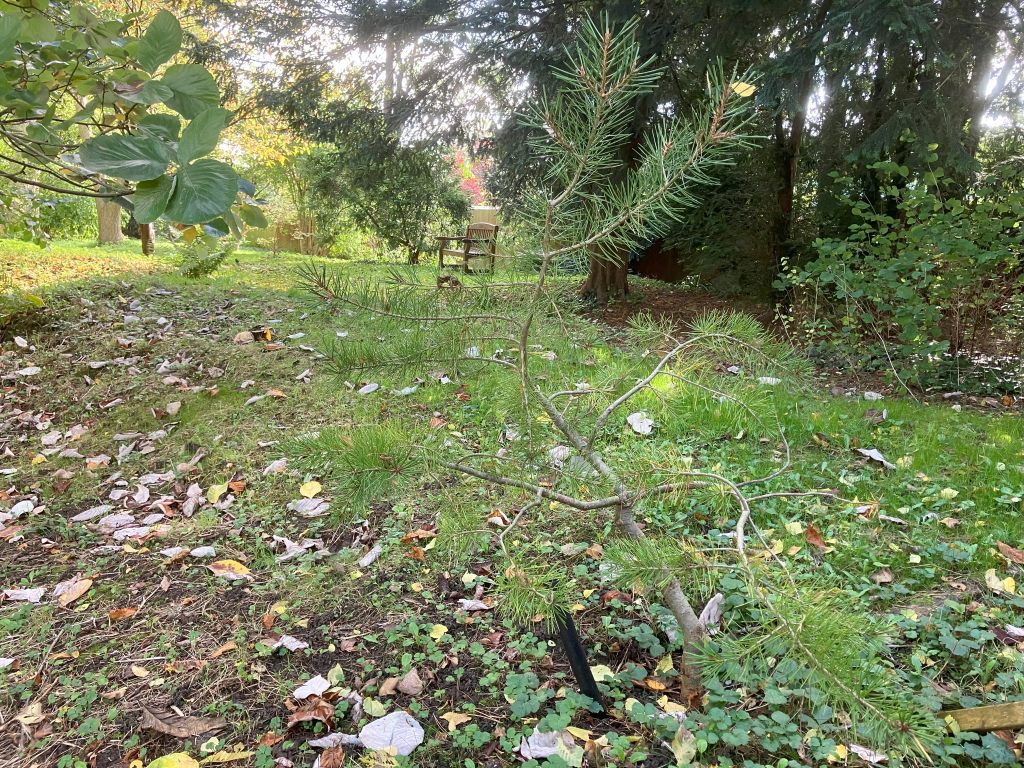
Planted: 2007
View On MapThis tree is at the western end of the Chinese and Japanese section, near the Edward Road fence.
| Distribution: | Native to northeastern and central China in the temperate forests in the mountains. Occurs in the wild on limestone rocks and south-facing slopes at elevations of 500 to 2,000 m. In the northern portion of its range, it also occurs on acidic soils. |
| Supplier: | Landford Trees, Salisbury, Wiltshire. |
| Growth Habit: | The trunk can grow either as a single growth upwards, or forked. Its crown is loosely shaped like a pyramid or umbrella. |
| Bark: | Widely cultivated as an ornamental tree, especially for its metallic bark. |
| Leaf: | Needles 5 to 10 cm long, in groups of three. Each cross-section is shaped in a triangular semicircle. |
| Cones: | The cones turn yellowish brown as they mature and are roughly egg-shaped; 5 to 7 cm long. |
| Seeds: | The cones contain seeds that are grey-brown, slightly egg-shaped, and 10 mm long. |
| Uses: | In China and Korea, the lacebark pine is traditionally planted near temples and cemeteries. The wood is is low grade and not commercially used as timber, except in northeast China. The seeds are edible and are used in traditional Chinese medicine. |
| Plant Hunter: | Its name is derived from the surname “Bunge”, Alexander Georg von Bunge (1803 – 1890), a Russian botanist. He was an early identifier of this species; in 1831 near Beijing |
| Introduction Date: | Introduced to England in 1843. |