#401 (M1) FOXGLOVE TREE
Paulownia tomentosa
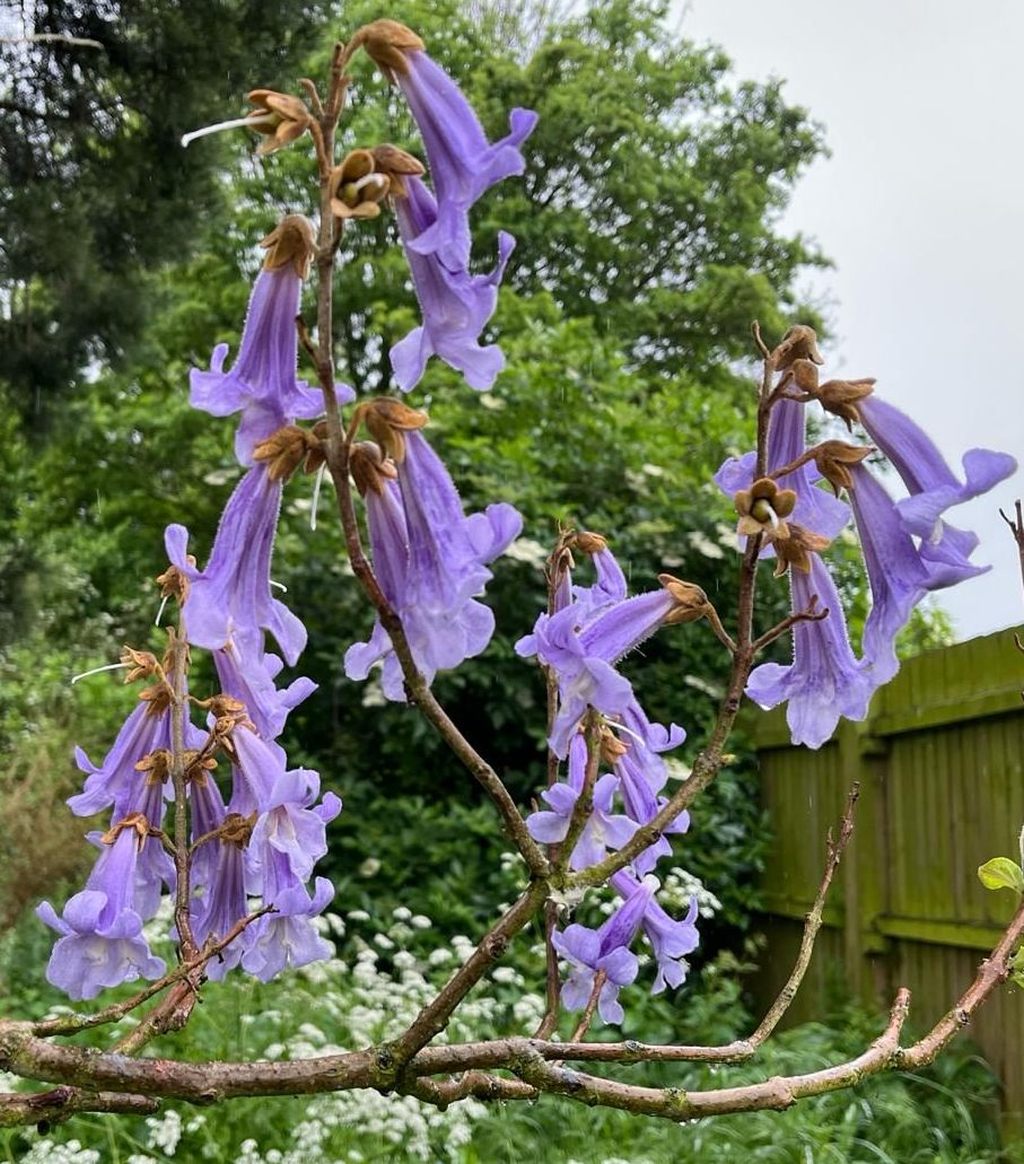
Planted: 2007
This tree can be found at the northern end of the Philadelphus Walk
| Other Common Names: | Princess Tree and Empress Tree | |
| Distribution: | Native to central and western China it has become naturalised in north America and parts of Europe. It seeds and suckers freely and has become an invasive species in parts of north America. | |
| Planting Date: | February 2007 | |
| Bought from: | Landford Trees, Landford Lodge, Salisbury, Wiltshire | |
| Appearance: | Fast growing, lage leaved deciduous tree | |
| Bark: | Smooth | |
| Leaf: | Large heart-shaped to five-lobed leaves 15 to 40 cm across, arranged in opposite pairs on the stem. On young growth, the leaves may be in whorls of three and much bigger. | |
| Flowers: | Very fragrant, large and violet-blue in colour are produced before the leaves in early spring. On panicles 10 to 30 cm long, with a tubular purple corolla 4 to 6 cm long resembling a foxglove flower. | |
| Fruit: | The fruit is a dry egg-shaped capsule 3 to 4 cm long, containing numerous tiny, winged seeds dispersed by wind and water. | |
| Ultimate size: | 10 to 25 m Pollarded trees do not produce flowers, these only form on mature wood. | |
| Uses: | Cultivated as an ornamental tree in parks and gardens. It has gained the Royal Horticultural Society’s Award of Garden Merit. Because of its tolerance and flexibility, Paulownia functions ecologically as a pioneer plant. Its nitrogen-rich leaves provide good fodder and its roots prevent soil erosion. The seeds were commonly used as a packing material by Chinese porcelain exporters in the 19th century, before the development of polystyrene packaging. Packing cases would often leak or burst open in transit and scatter the seeds. | |
| Plant Hunter: | Not known | |
| Introduction Date: | Not known | |
| Anecdotes and Comments: | The generic name Paulownia honours Anna Pavlovna (1795-1865). Daughter of the Emperor of Russia, she was Queen Consort by marriage to William 2nd of the Netherlands. Where she was known as Anna Paulowna. Tomentosa is a Latin word meaning ‘covered in hairs’. It has gained the Royal Horticultural Society’s Award of Garden Merit. | |