#384 (L4) WIER MAPLE
Acer saccharum f. laciniatum Wieri
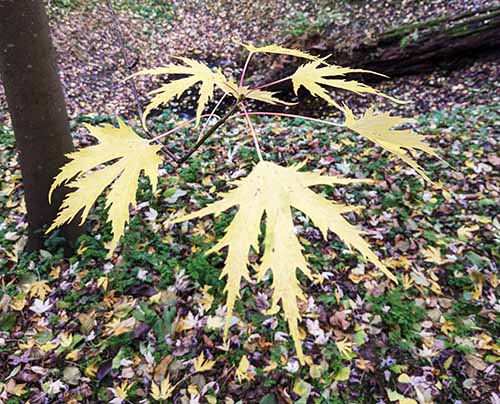
Planted: 2006
View On MapThis tree is on the west side of the Viburnum Walk, on the edge of the moat.
The cultivar Acer saccharum f. laciniatum Wieri was discovered in the Genesee Valley near Rochester, NewYork by Dr D B Wier of Lacon, Illinois, around 1870. It was subsequently introduced into commerce by the American firm Ellwanger and Barry in 1873.
| Distribution: | Central and north-eastern America |
| Supplier: | J Cheal and Sons, Lowfield Nurseries, Crawley. |
| Growth Habit: | Ultimately large, (25 m), ornamental tree resembling Norway Maple. |
| Bark: | Dark grey with broad fissures, becoming shaggy and gnarled. |
| Leaf: | To 10 cm long, and nearly the same across, with three or five toothed lobes. Fine red and gold colouring in Autumn after the first frost. |
| Flowers: | Small and red, or yellow, hang in clusters on very fine stalks in early Spring. |
| Fruit: | A pair of connected winged seeds, dependent on wind for dispersal. |
| Tree size in April 2023: | Height 18.5 m and girth 174 cm (at 1.5 m) |
| Uses: | Trees tapped in Spring, when the sap starts to rise. 150 litres of sap are needed to make 4 litres of Maple Syrup. |
| Plant Hunter: | In mid 16th century Jacques Cartier and fellow explorers, in Quebec, became the first Europeans to experience the sweet sap. By mistake, when they cut down what they believed to be a walnut tree. The sweet sap flowed freely. Evaporation through simmering was found to intensify the flavour and was compared to ‘good wine’. |
| Introduction Date: | Known in Europe since 1735 via the French colonists in Quebec. |
| Anecdotes and Comments: | In the 17th century the Huron Indians were known to consume the pure sap, and in times of famine, to chew on the tree bark for energy. |