#383 (L3) ITALIAN CYPRESS
Cupressus sempervirens
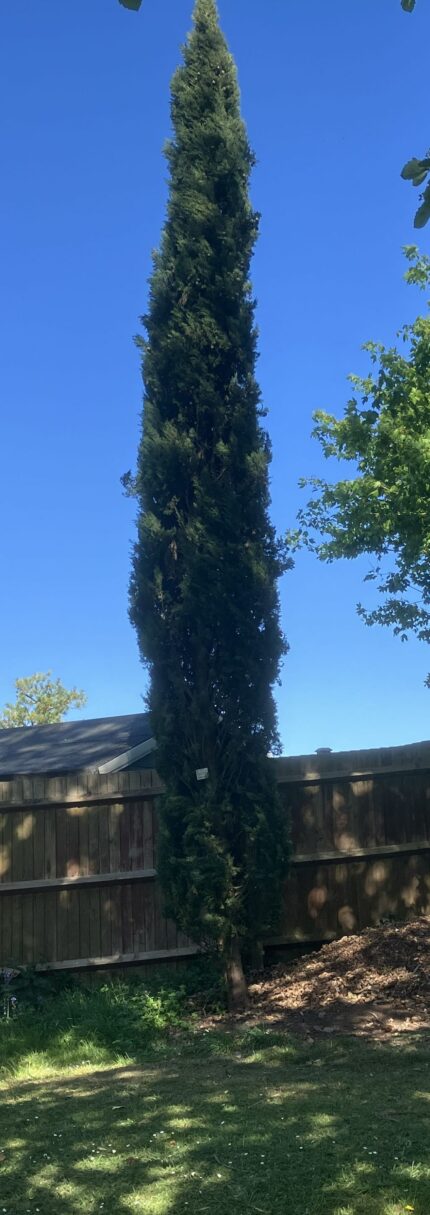
Planted: 2006
This tree is at the top of the Philadelphus Walk, next to the playing fields.
The Mediterranean cypress, Italian cypress, Tuscan cypress, or Persian cypress, is native to the eastern Mediterranean region and Iran. Important in Mediterranean and Middle Eastern culture. In Iran it is both a sacred tree and a metaphor for “the graceful figure of the beloved”.
A medium-sized evergreen growing up to 35 m tall, with a conic crown with level branches and variably loosely hanging branchlets. It is very long-lived, with some trees reported to be over 1,000 years old.
The foliage grows in dense, dark green sprays. The leaves are scale-like, 2 to 5 mm long, and produced on rounded (not flattened) shoots. The seed cones are ovoid or oblong and 25 to 40 mm long. The cones have 10 to 14 scales, which are green at first and mature to brown about 20 to 24 months after pollination. The male cones are 3 to 5 mm long and release highly allergenic pollen in late winter. Cones are often sealed, being released over a period of years.
The species name sempervirens comes from the Latin for ‘evergreen’.
Widely cultivated as an ornamental tree for thousands of years, outside of its native range.
The vast majority of the trees in cultivation are selected cultivars with a fastigate crown, with erect branches forming a narrow to very narrow crown often less than a tenth as wide as the tree is tall. The dark green “exclamation mark” shape of these trees is a highly characteristic signature of Mediterranean landscapes.
In folk medicine the dried leaves of the plant are used to treat various ailments. It is also the traditional wood used for Italian harpsichords.
In Iran the tree is called the “Graceful Cypress” (sarv-e nāz), and has a strong presence in culture, poetry and gardens. It bears several metaphors, including the “graceful figure and stately gait of [the] beloved”. Iranians maintain that a cypress was brought from paradise and planted near the first fire temple.
The oldest living cypress is in Iran’s Yazd Province, claimed to be approximately 4,000 years old, though there is no scientific evidence for this claim.
The cypress is often seen as symbol of mourning, and in the modern era, it remains the principal cemetery tree in both the Muslim world and continental Europe.
In Jewish tradition cypress is held to be the wood used to build Noah’s Ark and Soloman’s Temple.
In popular culture the cypress tree is associated with vacation destinations in the Mediterranean region, especially Italy.