#370 (E1) RED ALDER
Alnus rubra
Planted: 1999
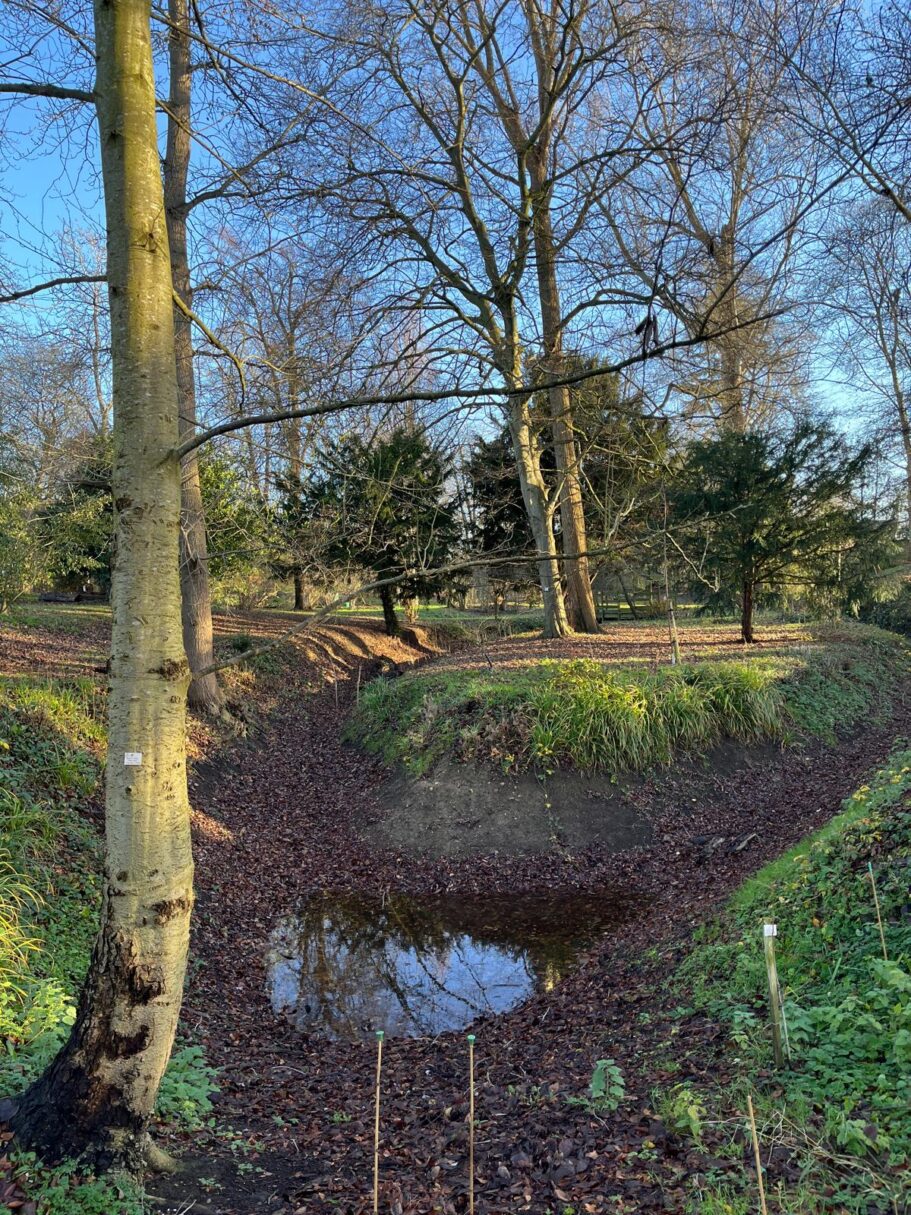
This tree is at the southern end of the viburnum walk, on the bank of the moat.
| Distribution: | Native to western North America from southeast Alaska south to central California, nearly always within about 200 km of the coast, to 900 m elevation. |
| Supplier: | The Times newspaper special offer. |
| Growth Habit: | A deciduous broad leaf tree, the largest species of alder in North America. |
| Bark: | Mottled, ashy-gray and smooth, often colonised by white lichen and moss. The name ‘Red Alder’ derives from the bright rusty red colour that develops in bruised or scraped bark. |
| Leaf: | The leaves are ovate, 7 to 15 cm long, with bluntly serrated edges and a distinct point at the end. The leaf margin is revolute, the very edge being curled under: which distinguishes it from all other alders. Rather than turning yellow in autumn, the leaves darken and wither before they fall. |
| Flowers: | The male flowers are dangling reddish catkins 10 to 15 cm long. Female catkins occur in clusters. |
| Seeds: | The female catkins develop into small, woody, cone-like, oval fruit 2 to 3 cm long. The seeds develop between the woody bracts of the ‘cones’; shed in late Autumn and Winter. They have a membranous winged margin to aid dispersal. |
| Uses: | The tree hosts nitrogen fixing nodules on its roots. This allows it to grow in nitrogen-poor soils and allows Red Alder to grow rapidly, and makes it effective in covering disturbed and/or degraded land. Alder leaves decay readily to form a nitrogen-enriched humus making nitrogen available to other species. The timber is not considered a durable option for outdoor applications, but due to its workability and ease of finishing it is increasingly used for furniture and cabinet making. Because of its oily smoke, it is the wood of choice for smoking salmon. A russet dye made from the bark, was used by Native Americans to dye fishing nets, so they were less visable underwater. Blackfeet Indians used an infusion made from the bark of red alder to treat lymphatic disorders and tuberculosis. Recent clinical studies have verified that red alder contains compounds shown to be effective against a variety of tumours. |
| Plant Hunter: | Unknown |
| Introduction Date: | Introduced to Britain in the late 1800s. |
| Anecdotes and Comments: | A Red Alder growing in Clatsop County, Oregon, US was measured at 32m in 1979. |