#368 (Sh.D13) SPINDLE TREE
Euonymus europaeus ‘Red Cascade’
Planted: 1998
View On MapThis shrub is on the south side of the Central Path, near the bridge.
‘Red Cascade’ is a cultivar of Euonymus europaeus. Fruits are poisonous.
A gift of former student George Woods.
Euonymus europaeus, the Spindle, European Spindle, or Common spindle, is native to much of Europe, where it inhabits the edges of forest, hedges and gentle slopes, tending to thrive on nutrient-rich, chalky and salt-poor soils.
A deciduous shrub, or small tree growing to 3 to 6 m tall, rarely to 10 m. With a stem up to 20 cm in diameter.
The leaves are opposite, lanceolate to elliptical, 3 to 8 cm long and 1 to 3 cm broad, with a finely serrated edges. The base is cuneate. Dark green in summer. Autumn colour ranges from yellow-green to reddish-purple, depending on environmental conditions.
The flowers are produced in late spring and are insect-pollinated. They are rather inconspicuous and small with yellowish-green petals, and grow in cymes of 3 to 8 together.
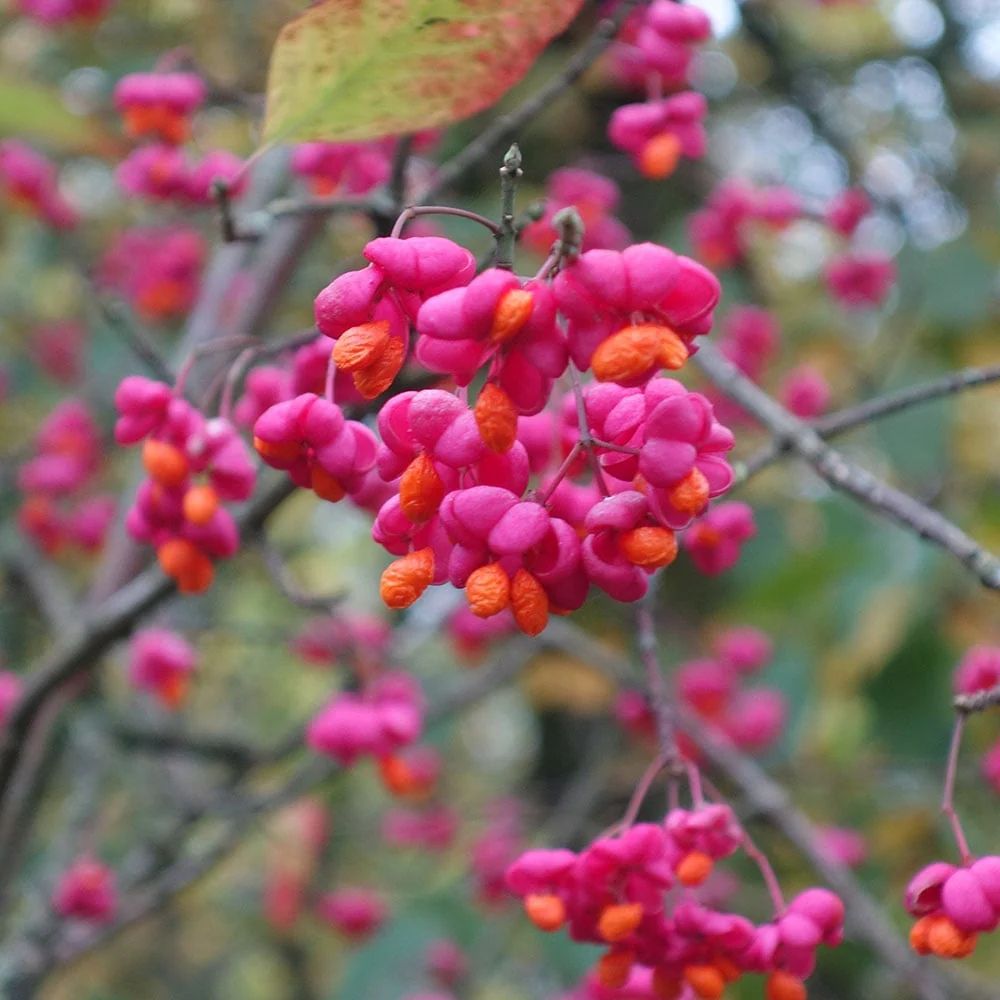
The capsular fruit ripens in autumn, and is red to purple or pink in colour and approximately 1 to 1.5 cm wide. When ripe, the four lobes split open to reveal the orange seeds.
It is a popular ornamental plant in gardens and parks due to its bright pink or purple fruits and attractive autumn colouring.
The wood is very hard, and can be cut to a sharp point. In the past it was used to make spindles for spinning wool and for butchers’ skewers.
Charcoal produced from this plant is held in high esteem among artists for its exceptional strength and density.
Parts of the plant have been used for medicinal purposes. However, the fruit is poisonous and contains several toxic substances. Poisoning is more common in young children, who are attracted to the brightly coloured fruits. Ingesting them can result in liver and kidney damage, or even death.
Euonymus europaeus is the almost exclusive winter host of the black bean aphid. This insect feeds on cultivated broad beans and sugar beet and Euonymus europaeus was removed from hedges and woodlands; as a measure against agricultural yield losses. Although this widespread removal does not appear to have impacted black bean aphid populations.
The cultivar ‘Red Cascade’ has gained the Royal Horticultural Society’s Award of Garden Merit.