#236 (Sh.36) CHINESE PLUM YEW
Cephalotaxus fortunii
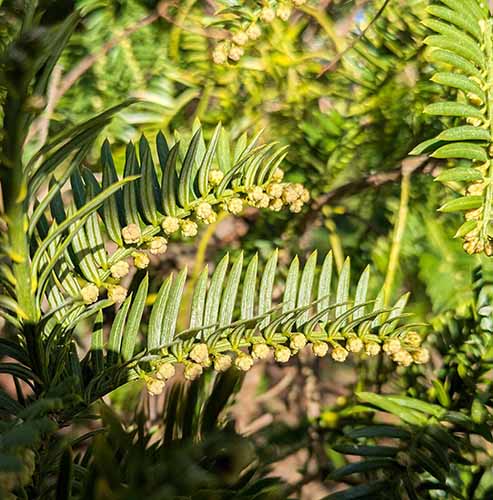
Planted: 1921
To be found at the western end of the Chinese and Japanese section.
The species is dioecious (separate male & female plants). Our tree is male.
| Distribution: | Native to northern Myanmar and China. Considered a rare evergreen in western gardens. |
| Supplier: | Little and Ballantine Nurserymen and Seedsmen, Carlisle, Cumbria. |
| Growth Habit: | An evergreen shrub or small tree growing to a hight of 20 m with a trunk diameter at breast height of about 20 cm. They are usually multi-stemmed with an open and loosely rounded crown. The branches are slightly pendulous. |
| Bark: | They have reddish brown bark that appears purplish in places with rough square scales and long shreds peeling off. The new shoots remain green for three years after emerging and are ribbed. |
| Leaf: | The leaves themselves are glossy on the upper surface and a deep yellowish-green to dark green in colour. They are borne almost horizontally from the branchlet typically measuring 3.5 cm to 12.5 cm, though they can be as short as 1.5 cm, by 3.2 mm to 5 mm wide, though they sometimes are as narrow as 1.5 mm |
| Cones: | Male, pollen producing: The male cones form in small bunches of 6 to 14 in the axils of the leaves. Each cone has 4 to 6 pollen sacs. Female, seed producing: The seed cones are borne together in groups of 3 to 6 at the end of branchlets. |
| Fruit: | The fruit, on the female tree, measure 1.4 to 2.5 cm long by 0.9 to 1.5 cm wide and have several indistinct striations or prominent longitudinal ridges. Red, when ripe, with a sweet pine-like flavour. |
| Toxicity: | Leaves. bark and seeds are toxic if ingested. |
| Uses: | Grown as an ornamental tree. |
| Plant Hunter: | Named after Robert Fortune (1812 – 1880) a Scottish horticulturist and plant hunter who introduced the species to the UK in 1848. |