#223 (Sh.23) COMMON BOX
Buxus sempervirens ‘Handworthensis’
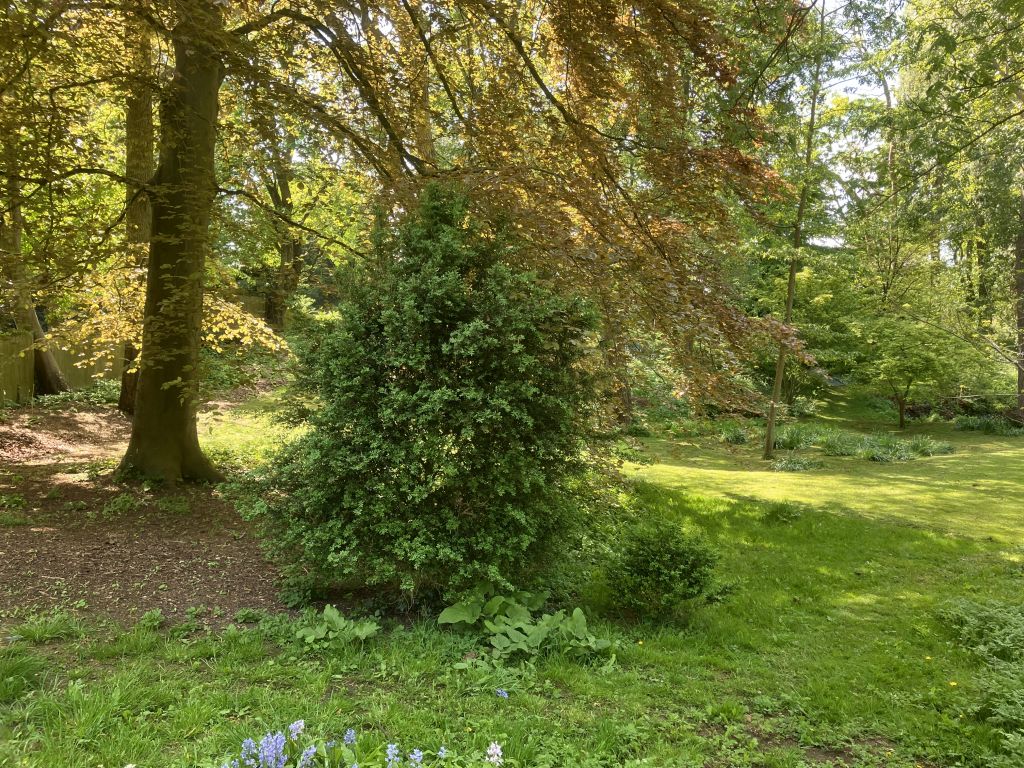
Planted: 1928
This specimen is at the bottom of the East Walk.
| Distribution: | Native to Europe, where it grows wild from the British Isles to the Mediterranean. Grows wild in scrubland, hills, and other dry, rocky terrain in Europe and Asia Minor. |
| Supplier: | Purchased from Hilliers Nursery, Romsey, Hampshire. Planted as hedge of 6 box varieties along a curved path from the East Walk to the ‘Main Avenue.’ |
| Growth Habit: | Shrubby or tree-like; exceptionally reaches 12 m in height, with a highly branched stems. |
| Bark: | Smooth bark in young specimens, furrowed with cracks in adults, and of a greyish-brown colour. |
| Leaf: | Lanceolate to ovate or elliptical, opposite, leathery, dark green on the upper surface and lighter on the underside, up to 30 mm long, with the margin slightly curved downwards. |
| Flowers: | Both male and female flowers are present on the same plant; they appear in early spring in small inflorescences of several male flowers and one female flower in the leaf axils. They measure about 2 mm, are yellow, inconspicuous, lack a corolla, have no fragrance but are rich in nectar. |
| Fruit: | A brown or grey, leathery capsule , about 1 cm long, containing numerous seeds. |
| Uses: | From classical times, it was used in Greece and Rpme to demarcate gardens by forming hedges. The wood is very hard fine grained and yellowish in colour, Used for woodcarving and as a substitute for ivory and ebony (when suitably stained). In cabinet making it is used for turning and small household utensils due to its homogeneous, non-fibrous structure (spoons, spatulas, etc.). Boxwood chess pieces are archetypal. |
| Plant Diseases: | Susceptible to the fungus Pseudometria fousseliana which causes boxwood canker , characterized by pink or bright red pustules on the leaves and branches. This disease significantly reduces the plant’s vigour and can eventually kill it. Mycosphaerella patouillardi which causes leaf drop and manifests as persistent white mottling. Phyllosticta buxina which shows symptoms similar to citrus canker. Phytophthora cinnamomi which affects the root in an incurable way. Since its introduction to Europe in 2006, the box tree moth ( Cydalima perspectalis ) has caused severe defoliation and becoming a pest in some areas. |
| Introduction Date: | Native to the British Isles. |
| Toxicity: | The leaves, bark and fruit are very toxic, Its use is extremely dangerous; and can cause vomiting. Higher concentrations are fatal to humans. But not to some birds that disperse the seeds. |
| Anecdotes: | JD Bean 1914 Buxus sempervirens ‘Of the numerous named varieties cultivated in gardens, some of which scarcely differ from each other, Buxus sempervirens var. Handworthii is one of the most distinct. Habit vigorous, densley bushy , but somewhat erect. Leaves large and broad.’ |