#220 (Sh.20) ROUEN OR CHINESE LILAC
Syringa × chinensis
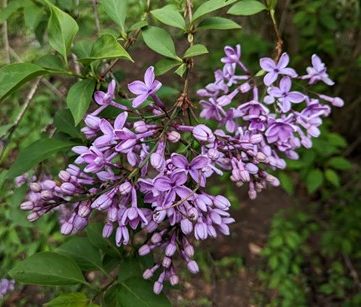
Planted: 1922
This shrub is on the east side of Syringa Avenue.
| Distribution: | A hybrid between Syringa vulgaris (Common Lilac) and Syringa persica (Persian lilac). In spite of its specific and common names, it most probably originated in western Asia, not China. |
| Supplier: | Hillier Nurseries, Romsey, Hampshire. Planted in the Chinese Garden in March 1922. Transplasnted to its present location in February 1933. |
| Growth Habit: | A deciduous bush of dense rounded habit 3 to 4.5 m tall. The growths made during summer produce, the following May, a pair of flower-trusses making a heavy, arching, compound panicle. |
| Leaf: | Ovate, rounded or broadly wedge shaped at the base taper pointed. On a smooth stalk. |
| Flowers: | Single, pink to bluish-pink in large panicles. Scant fragrance. |
| Fruit: | Sometimes produces fertile seeds. |
| Toxicity: | Not known |
| Uses: | Ornamental |
| Introduction Date: | 1795 |
| Anecdotes and Comments: | Description in W J Bean ‘Trees and Shrubs Hardy in the British Isles’ 1st Edition 1914, as used by Mr Hammond: ‘Said to have been raised in the Botanic Garden of Rouen by Mr Vardin in the last quarter of the eighteenth century; introduced to Britain in 1795. There is nothing improbable in this story, but the plant was known in China for more than one hundred years, where it is common in cultivation.‘ It is quite possible the hybridization occurred several times in collections where the two parents were grown in close proximity. Three named cultivars are listed in W J Bean ‘Trees and Shrubs Hardy in the British Isles’ 1st Edition 1914, as used by Mr Hammond : ‘Alba’ Flowers very pale lilac, nearly white. ‘La Lorraine’ Flowers a rosy-lilac. ‘Saugeana’ (‘Rubra’) Flowers lilac-red. This specimen does not conform to any of these descriptions. |