#388 (L8) CHARLOTTE'S CRABAPPLE
Malus coronaria ‘Charlottea’
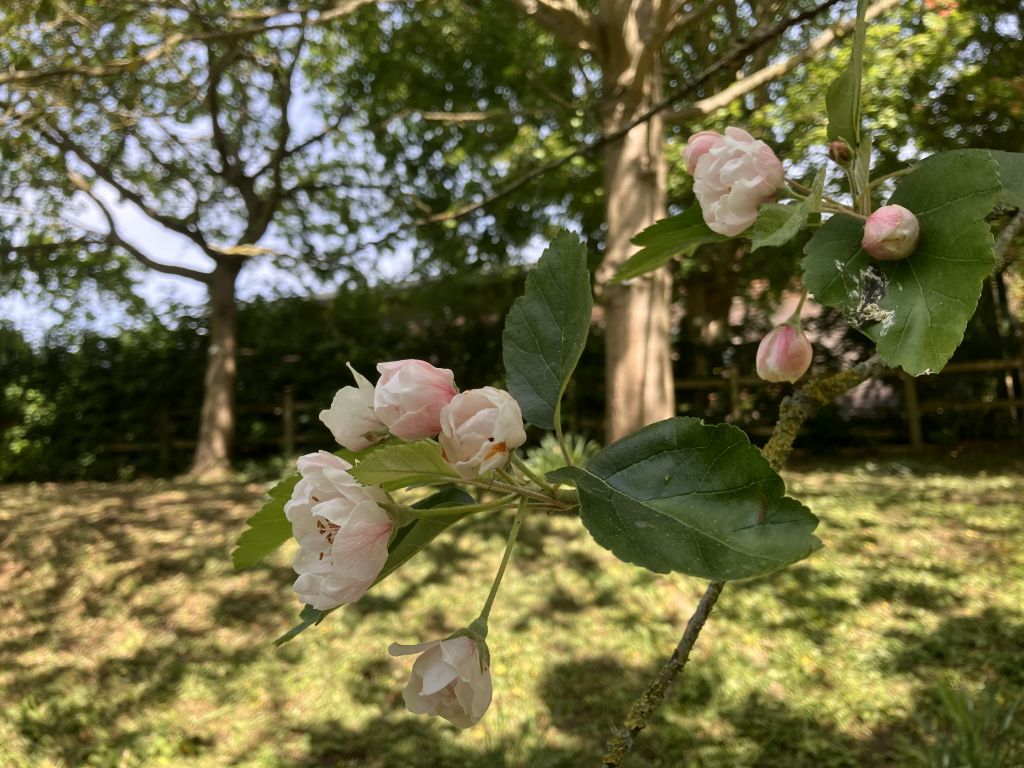
Planted: 2006
This tree is on the north bank at the eastern end of the Malus Avenue.
| Distribution: | Malus coronaria is a North American species of crabapple. Also known as sweet crabapple or garland crab. It grows primarily in the Great Lakes Region and the Ohio Valley. The cultivar of Malus coronaria was discovered as a naturally occurring seedling in 1902 near Waukegan, Illinois, by Edward de Wolf and named after his wife. |
| Supplier: | Purchased from |
| Growth Habit: | A bushy shrub with rigid, contorted branches, but frequently becomes a small tree up to 10 m tall, with a broad open crown. |
| Bark: | The bark is reddish brown, longitudinally fissured, with surface separating in narrow scales. Branchlets at first coated with thick white wool, later they become smooth reddish brown; they develop in their second year long, spur-like branches; sometimes thorns 2.5 cm in length. |
| Leaf: | Leaves are alternate, simple, ovate, 7.5 to 10 cm long, 4 to 5 cm wide, obtuse and often three-lobed on vigorous shoots, acute at apex. Feather-veined, midrib and primary veins grooved above, prominent beneath. They come out of the bud red bronze and downy. When full grown they are bright dark green, paler beneath. In Autumn the leaves turn yellow. |
| Flowers: | The flowers bloom from May to June, when leaves are nearly grown. They are rose-coloured and fragrant, 4 to 5 cm across. Borne in five or six-flowered umbels on slender pedicels. The corolla has five petals which are rose coloured and has 10 to 20 stamens. |
| Fruit: | The fruit is an apple ripening in October, 2.5 to 4 cm in diameter. The skin is yellow green, delightfully fragrant, with a sometimes waxy surface. The flesh is white and the seeds are chestnut brown. |
| Uses: | Malus coronaria ‘Charlotte’ is grown as a ornamental. The wood of Malus coronaria is brown, heavy and close-grained; but not strong. Used for the handles of tools and small domestic articles. The sour fruit is used in jellies, preserves, cider, and for baking, while the tree provides food/habitat for birds and pollinators. |
| Introduction Date: | 1902 |