#364 (D9a) WILD CHERRY
Prunus avium
Planted: 1998
This tree is in the Chinese and Japanese section, on the bank to the north
Other common names are: Sweet Cherry or Gean.
Native to Eurasia and Europe, including the British Isles. The species is widely cultivated in other regions and has become naturalised in North America, New Zealand and Australia.
One of several seedlings raised by Angela Maidwell, Headmistress at the school, and planted here.
An item of human food for several thousands of years. The stones have been found at Bronze Age settlements throughout Europe.
All parts of the plant except for the ripe fruit are slightly toxic.
A deciduous tree growing to 5 to 25 m tall, with a trunk up to 1.5 m in diameter.
The bark is smooth reddish-brown with prominent horizontal grey-brown lenticles on young trees, becoming thick dark blackish-brown and fissured on old trees.
The leaves are alternate, simple ovoid-acute, 7 to 14 cm long and 4 to 7 cm wide. Glabrous matt or sub-shiny green above, variably finely downy beneath, with a serrated margin and an acuminate tip. With a green or reddish penticle 2 to 3.5 cm long bearing two to five small red glands. In Autumn, the leaves turn orange, pink or red before falling.
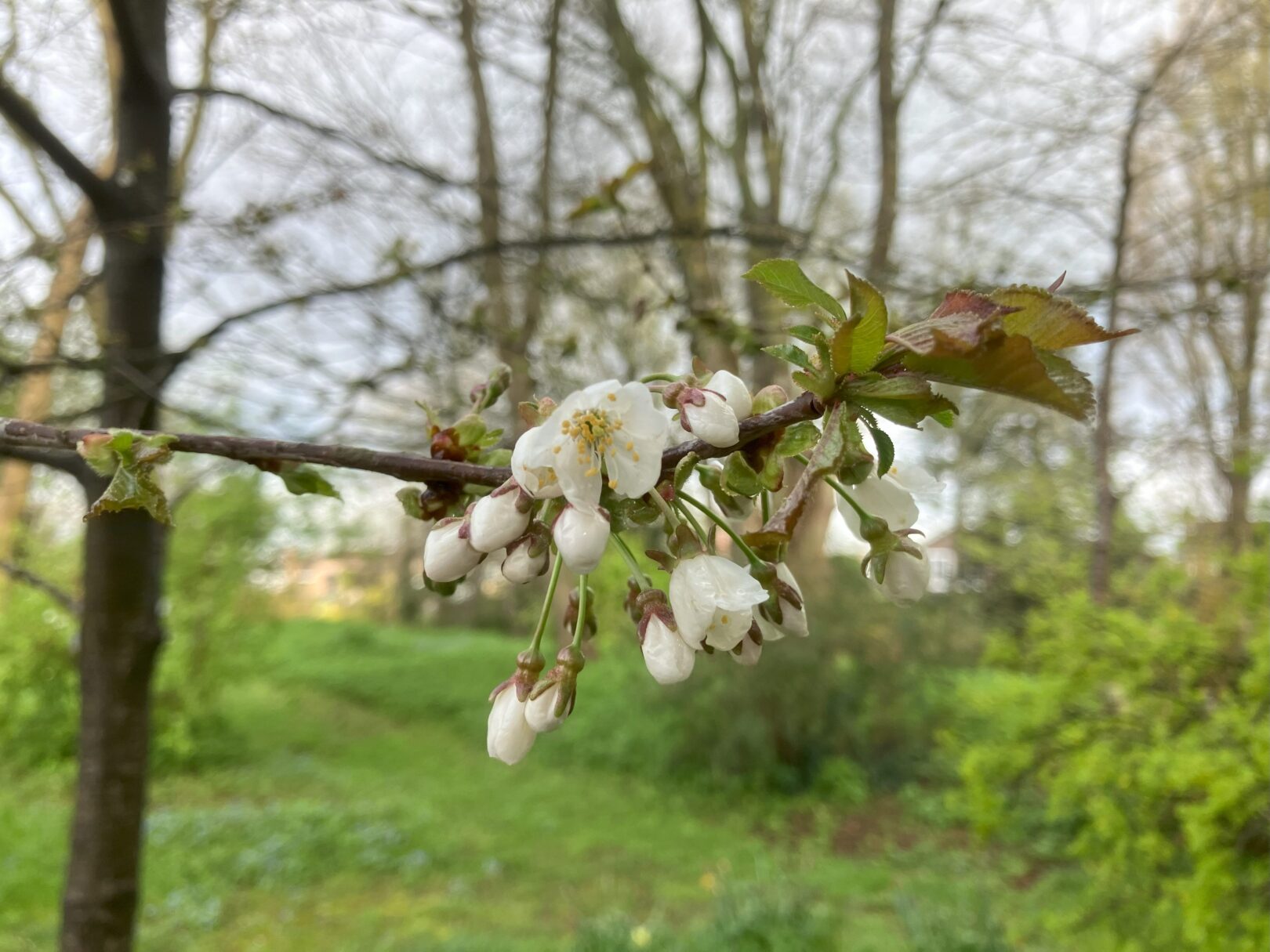
The flowers are borne in corymbs of two to six together, each flower pendent on a 2 to 5 cm peduncle, 2.5 to 3.5 cm in diameter. With five pure white petals and yellowish stamens. They are pollinated by bees.
The fruit is 1 to 2.5 cm in diameter, bright red to dark purple when mature in midsummer. Variably tasting sweet to somewhat astringent and bitter when fresh. Each fruit contains a single hard-shelled stone 8 to 12 mm in diameter.
The hard, reddish-brown ‘cherry wood’ is valued as a hardwood. It is also used for curing food by smoking, particularly meats, as it lends a distinct and pleasant flavour.