#363 (D8) MIDLAND HAWTHORN HYBRID
Crataegus laevigata ‘Paul’s Scarlet’
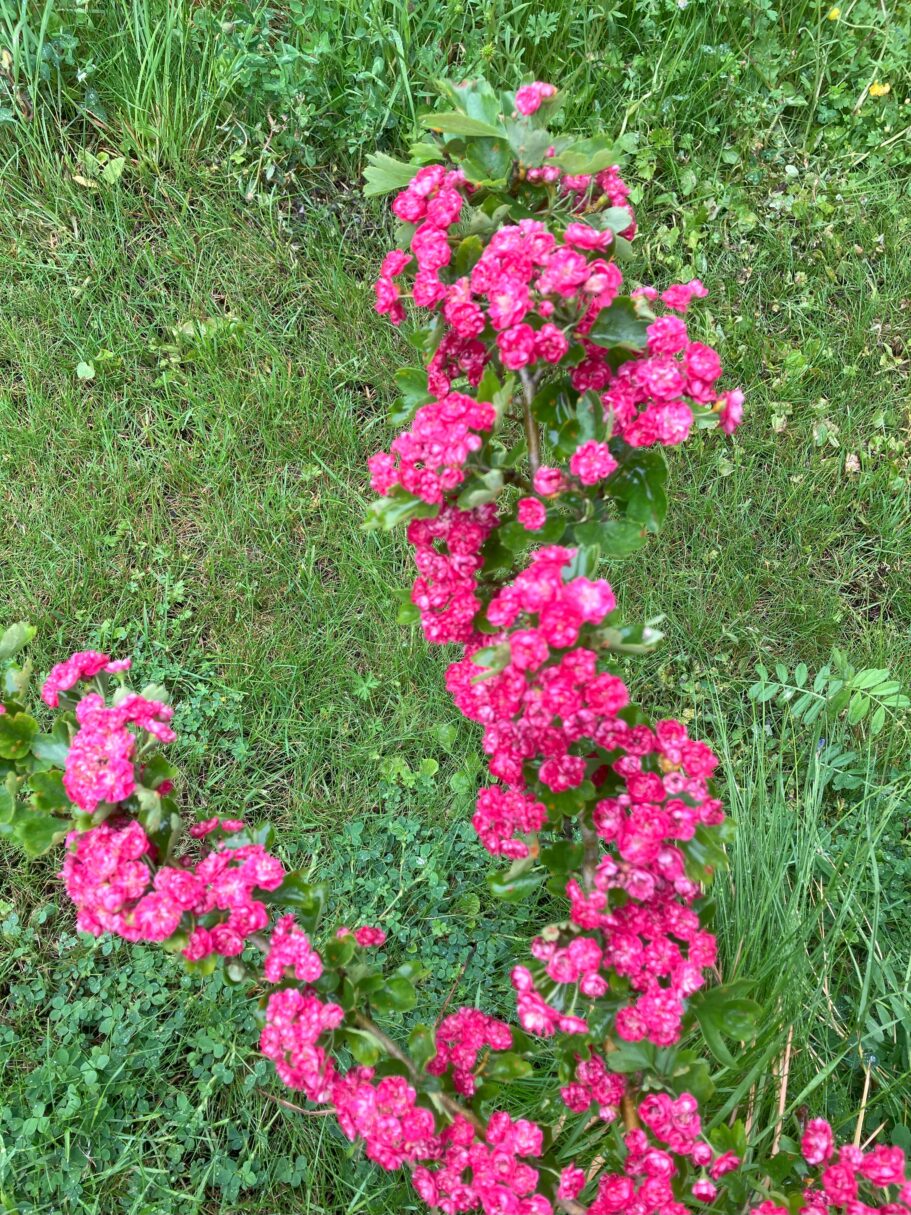
Planted: 1998
This tree is on the northern bank of the Malus Avenue, near the entrance.
| Distribution: | A cultivar of Crataegus laevigata, known as the Midland hawthorn, English hawthorn, woodland hawthorn, or mayflower, is native to western and central Europe, from Great Britain (where it is typically found in ancient woodland and old hedgerows) and Spain, east to Romania and Ukraine. |
| Supplier: | Purchased from Goscote Nurseries, Cossington, Leicestershire. A gift of Rachel Root |
| Growth Habit: | A large shrub or small tree growing to 8 m, rarely to 12 m, with a dense crown. Distinguished from the closely related common hawthorn, Crataegus monogyna in the leaves being only shallowly lobed, with forward-pointing lobes, without hair tufts in the vein axils, and in the flowers having more than one style. Each style produces a seed, so its fruits also have more than one seed and these make them slightly oval, in contrast with the single-seeded and therefore round fruits of common hawthorn. |
| Bark: | Rough and fissured in older trees. |
| Leaf: | The leaves are 2 to 6 cm long and 2 to 5 cm wide, with two or three shallow, forward-pointing lobes on each side of the leaf. |
| Flowers: | Produced in corymbs of 6 to 12. Each flower with five white or pale pink petals and two or sometimes three styles. Pollinated by insects. |
| Fruit: | A dark red pome 6 to 10 mm diameter, containing two or three nutlets. |
| Uses: | Mainly ornamental but retains the characteristics of the common hawthorn, Crataegus monogyna, as a hedgerow plant. |
| Plant Hunter: | Crataegus laevigata was described botanically as a separate species in 1798 by Jean Louis Marie Poiret (1755 – 1834) French clergyman, botanist and explorer. The Cultivar ‘Paul’s Scarlet’, with double red flowers, was discovered by Christopher Boyd growing in his garden near Waltham Cross in 1858. It is a naturally occurring mutation of the pink native double-flowered Midland Hawthorn Crataegus laevigata ‘Rosea Flora Pieno’. It was subsequently propagated and popularised in the 1860s by William Paul (1823 – 1905) horticulturalist, author and nurseryman. |
| : |