#343 (B1) PERE DAVID'S MAPLE
Acer davidii
Planted: 1996
This tree is on the bank, to the south of the Moat Path and near the moat steps.
| Distribution: | Native to China. |
| Supplier: | Unknown |
| Growth Habit: | A small deciduous tree growing to 10–15 m tall with a trunk up to 40 cm in diameter, though usually smaller and often with multiple trunks, and a spreading crown of long, arching branches. |
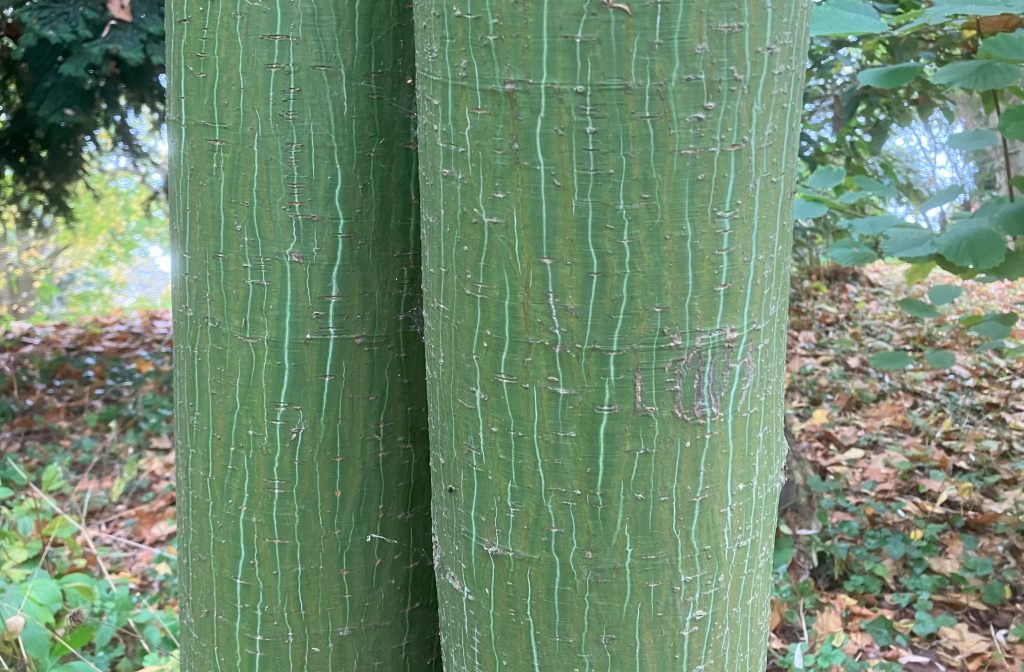
| Bark: | The bark is smooth, olive-green with regular narrow pale vertical stripes on young trees, eventually becoming dull grey-brown at the base of old trees and leading to the term ‘snake bark’. |
| Leaf: | The leaves are 6 to 18 cm long and 4 to 9 cm wide, with a petiole 3 to 6 cm long. They are dark green above, paler below, ovate, unlobed or weakly three-lobed, with a serrated margin. They turn to bright yellow, orange or red in the Autumn. |
| Flowers: | Small, yellow, with five sepals and petals about 4 mm long. They are produced on arching to pendulous 7 to 12 cm racemes in late Spring, with male and female flowers on different racemes. |
| Fruit: | The fruit is the typical two winged ‘propeller’ called a samara. The nutlets are 7 to 10 mm long and 4 to 6 mm wide, with a wing 2 to 3 cm long and 5 mm wide. |
| Toxicity: | Unknown |
| Uses: | A deciduous ornamental tree. |
| Plant Hunter: | First discovered and described by French botanist and missionary Pere Armand David. The tree was later rediscovered by Charles Maries during his exploration of Jiangsu, while collecting for Veitch’s nurseries. |
| Introduction Date: | 1879 |