#335 (A35) KATSURA
Cercidiphyllum japonicum
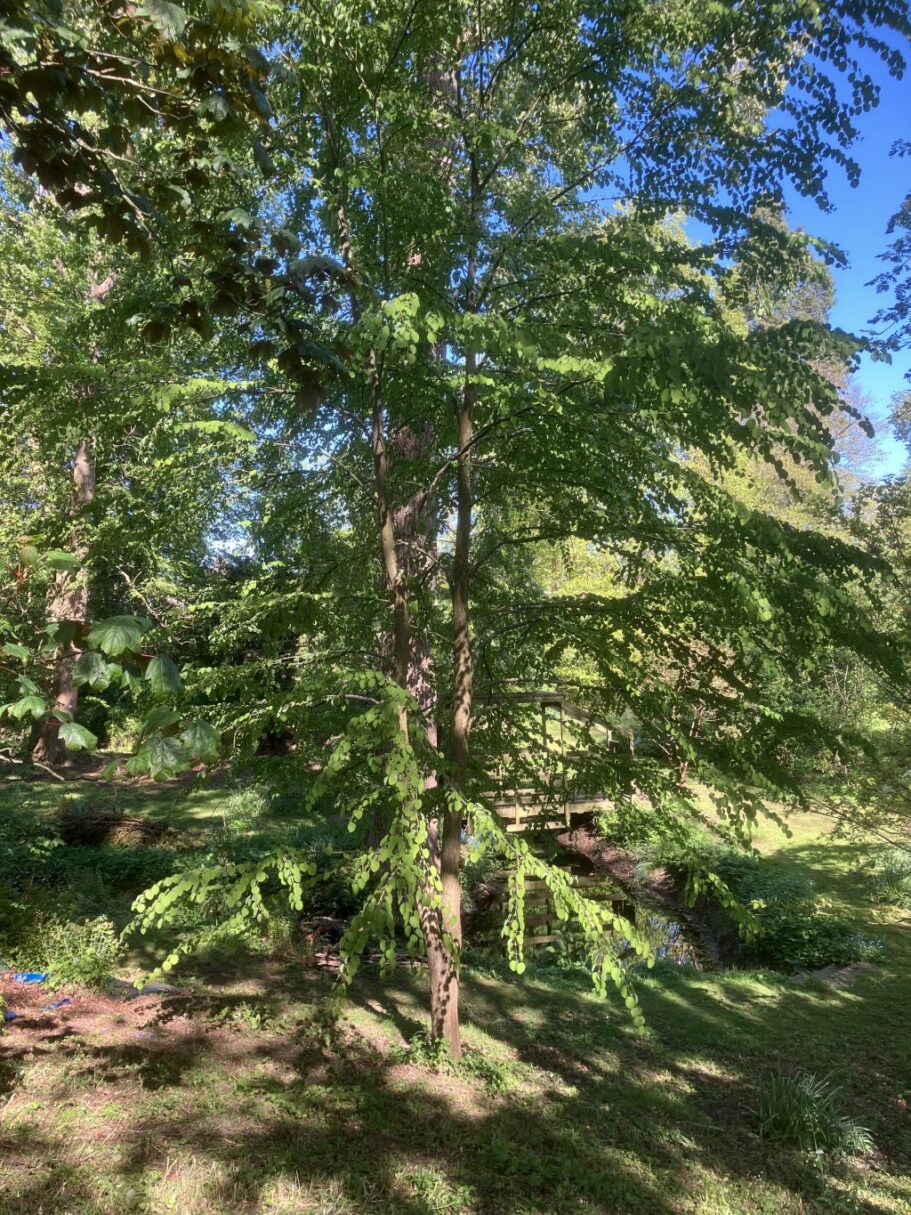
Planted: 1995
This specimen can be found on the east side of the Moat Path, near the moat steps.
| Distribution: | Cercidiphyllum japonicum is a naturally occurring cultivar of Cercidiphyllum and is known as Katsura (from its Japanese name カツラ, 桂). It is native to China and Japan. Sometimes called caramel tree or candyfloss tree because of the scent emitted by falling leaves during autumn. Listed as endangered in China. But overall, when Japanese populations are included, it is classified as being lower risk. |
| Supplier: | Hillier Nurseries, Romsey, Hampshire. |
| Growth Habit: | The tree is deciduous and grows to 10 to 45 m, with a trunk diameter of up to 2 m (rarely more). |
| Bark: | Long shoots form the structure of the branches, short shoots are born from their second year onward. |
| Leaf: | The leaves are produced in opposite pairs on long shoots and singly on short shoots; they have a 1.4 to 4.7 cm petiole, and are rounded with a heart-shaped base and a crenate margin. Leaves on short shoots are the largest, 3.7 to 9 cm long and 5 to 8.3 cm wide. Those on long shoots, smaller, being 3.2 to 4.5 cm long and 1.9 to 3.2 cm wide. The leaves turn a variety of pinks and yellows in Autumn. |
| Flowers: | Inconspicuous and produced in Spring, among the opening leaves. Male and female flowers are on separate plants. |
| Fruit: | The fruit, on the female plant, is a cluster of two to four follicles 1 to 1.8 cm long and 2 to 3 mm wide with each follicle containing several winged seeds. |
| Uses: | Katsura is a popular ornamental tree in Japan where it is also grown for its timber, used in construction and woodworking. |
| Plant Hunter: | Katsura trees were first introduced to the US by Thomas Hogg Jr. around 1865. Hogg served as a diplomat in Japan under President Lincoln. |
| Introduction Date: | Before 1881. |
| Anecdotes and Comments: | Several cultivars of Cercidiphyllum, including Cercidiphyllum japonicum, have gained the Royal Horticultural Society’s Award of Garden Merit. |